|
CAERI builds Chinas most precise and universal crash facility with German technology
The gigantic facility in Chongqing was planned and built by the German
company MESSRING / Vast range of crash scenarios and automobile certification tests performable
Munich/Germany, 2. September 2014 - Numerous developments in the area of
vehicle safety are significantly influenced as a result of current NCAP or NHTSA regulations and then realized and implemented by manufacturers and
their suppliers. The situation in China is similar, only that it’s not the rules and guidelines of the different
associations but several state authorities are responsible for testing and the development of new protocols.
Between 2010 and 2013, the German company MESSRING planned, constructed, and installed a crash-test
facility that sets new global standards for CAERI, the institute located in Chongqing. CAERI, was founded in 1965
and is responsible for all tests involving vehicle models (motorcycles, cars, buses, and trucks). A further
business segment is the provision of its state-of-the-art crash-test facilities for domestic automobile manufacturers and suppliers like Changan.
Following an open tender for the gigantic crash-test facility and productive negotiations in February 2010, CAERII
decided to commission the specialists from MESSRING with the realization of the project. The contract with the
world-leader in the crash-test facilities segment reads as follows: the construction of a testing center in which
virtually all globally recognized automobile certification tests can be performed, including the installation of all
necessary system technologies and sensoring systems. A welcome challenge for the company from Krailling,
close by Munich, which had already planned and constructed more than 100 crash-test facilities throughout the
world, and alone ten of these in China. As Dierk Arp, CEO at MESSRING, reports “Our activities in China began at
quite an early stage, and we were naturally particularly pleased that our bid for this gigantic facility was successful.”
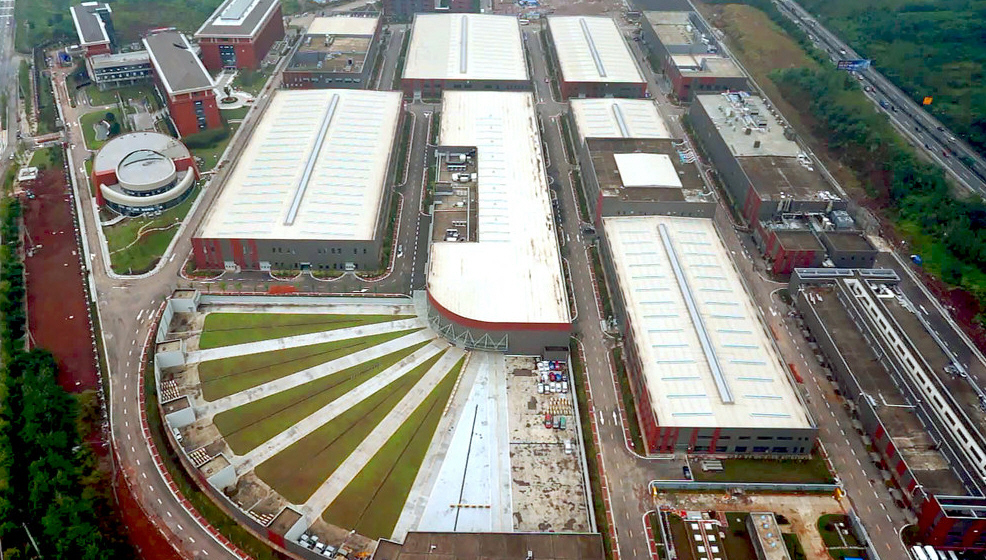
Considering the dimensions of the construction work involved on its own, the project in Chongqing is unique.
Alone the building containing the crash-test facility has a gross floor space of 25,000 m2, the acceleration track
for automobile tests has a length of 294 meters (200 m are roofed over and the rest is outdoors), and a second,
variable-angle, oblique impact track was installed that allows any angle of incidence adjustments to the main
acceleration track. This permits the simulation of a broad spectrum of collision scenarios involving two vehicles.
“As a public institute, it is our responsibility to improve vehicle and traffic safety in China and make driving safer
for the people. The fact that we saw all our criteria fulfilled in terms of the planning and construction of the crash
-test facility was instrumental in our decision to choose MESSRING”, says Mr. Xu Wei, Deputy Director for Vehicle Safety at CAERI.
The system at CAERI is powered by two electric propulsion systems, developed especially for use in crash tests.
Together, the two electric motors have a combined power rating of 2.4 megawatts. This allows vehicles with
overall weights of up to five tonnes to be accelerated to a speed of 120 km/h before they collide with the impact
block. Even high speed crashes with 25-tonne trucks and buses can be simulated with this system - a unique
capability, offered only by the facility in China. Nevertheless, the complete facility must work with exceptional
precision, despite the high velocities and extreme forces used in testing vehicles at Chongqing. The tolerance
limits defined by CAERI during the approval and acceptance of the facility in May 2013 were correspondingly tight
. The maximum permitted deviation in speed with the track system under full load was only +/- 0.15 km/h and the
precision with which two test vehicles collide in Car2Car tests had to be within a maximum tolerance bandwidth
of +/- 1 centimeter. These values were met without any problems and the facility was handed over and went into operation on schedule.
In addition to the frontal and oblique impact systems mentioned earlier, MESSRING also supplied numerous testing
components to complete the gigantic testing complex. These are of particular importance to permit the
implementation of further, international, testing procedures, for instance from the USA and EU. CAERI relies not
only on system technologies provided by MESSRING, but also on a comprehensive package of sensoring and data logging systems “Made in Germany” for the precise documentation of crash tests.
Mr. Yue Zhong Yao, Deputy Director for Vehicle Safety at the Chongqing Automotive Engineering Research
Institute is extremely satisfied with the completed project. “The collaboration with MESSRING proved to be
extremely positive and was characterized by mutual respect. The product of our collaboration - the new testing
center in Chongqing - represents a milestone for CAERI and the advancement of car safety throughout China.”
Press Photos (Copyright CAERI)
The CAERI crash test facility aerial shot: https://www.flickr.com/photos/waechterwaechter/15105983972/sizes/l
The track system has a length of 294 meters: https://www.flickr.com/photos/waechterwaechter/15083350776/sizes/l
A Car2Car test buildup taking place within the facility:https://www.flickr.com/photos/waechterwaechter/14919711630/sizes/l
For more information, go to www.messring.de
Press Contact:
Enno Hennrichs
Talk of Town.
Wächter & Wächter
Lindwurmstrasse. 88
80337 Munich
Phone +49-89-747242 – 39
Fax – 60
e.hennrichs@waechter-waechter.de
www.talkoftown.de www.twitter.com/talkoftown.de www.facebook.com/talkoftownpr
Download Press Release in pdf
|